Minesweeper patterns explained: read the numbers, never guess
Learn the number patterns behind Minesweeper-style puzzles: single-neighbour ones, satisfied numbers, the 1-2-1 and 1-2-2-1 lines, and safe opening moves.
Minesweeper has been bundled with computers since the early 1990s, and plenty of people who played it back then still think of it as a guessing game. It is not. Almost every square on a well-made board can be worked out from the numbers around it. Once you learn to recognise a few patterns, the board reads almost like a sentence, and the clicks stop being nervous.
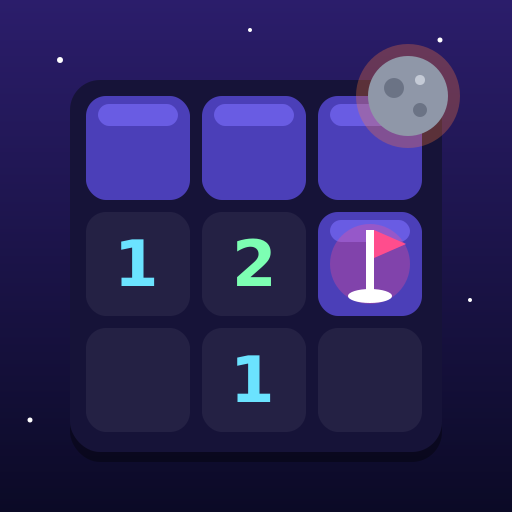
This guide uses the same rules as most mine-style puzzles: each open square shows how many hidden dangers touch it, counting all eight neighbours, diagonals included. In our Minesweeper the dangers are asteroids and you mark them with beacons, but the logic is identical.
The two questions every number answers
Every number on the board lets you ask two simple questions.
- Are all of its hidden neighbours dangers? If a number touches exactly as many hidden squares as its value, every one of those squares is a danger. A 2 with only two hidden squares next to it has nowhere else to put its two.
- Are all of its dangers already found? If a number already touches as many marked dangers as its value, every other hidden square around it is safe. A 1 that already touches a flag or beacon is satisfied, so its other neighbours can be opened.
Those two checks solve a surprising share of any beginner board. Go around the edge of the open area and ask both questions of each number, mark what you can, open what you can, and repeat.
Let the game open squares for you
Many mine-style games let you tap a satisfied number to open all of its remaining neighbours at once. It is often called chording. In our Minesweeper, tapping a number whose beacons are all placed scans every other hidden square around it. This saves a lot of tapping, but it also punishes careless marking: if one of your beacons is wrong, the chord will open a real asteroid. Only chord when you are sure of every mark.
Compare neighbouring numbers
When the simple questions run out, look at two numbers side by side. Suppose a 1 and a 2 share most of their hidden neighbours, and the 2 touches one extra hidden square that the 1 does not. The 1 can only place one danger in the shared squares, so the 2 needs its second danger somewhere outside them. If there is only one such square, it is a danger.
This "subtract one number from another" idea is the heart of every advanced technique. The patterns below are simply common cases of it that are worth memorising.
The 1-2-1 along a wall
Picture a row of open numbers running along a straight edge of hidden squares: 1, 2, 1. The dangers sit under the two 1s, and the square under the 2 is safe. You can check it with the subtraction idea: the left 1 and the 2 share two squares, so the 2's extra danger must be on the right, and the same reasoning from the other side puts one on the left.
The 1-2-2-1 along a wall
Now picture 1, 2, 2, 1 along the same kind of edge. This time the dangers sit under the two 2s, and the squares under the 1s are safe. When you spot either of these lines on a real board, you can mark them instantly without working through the logic again.
Corners and edges are your friends
Squares on the edge of the board have fewer neighbours, so their numbers are more informative. A 3 in a corner of the open area that touches only three hidden squares fills all three. When you feel stuck, run your eye along the borders first.
Count what is left
Near the end, most games show how many dangers remain. That count can settle the last few squares. If three hidden squares remain in an isolated pocket and only one danger is unaccounted for, the numbers next to the pocket often tell you which one.
Should you ever guess?
In the classic game, some boards force a guess, usually right at the start or in a sealed corner at the end. Many modern versions, including ours, build each field so that it can be solved from the numbers alone, and the first scan always opens a safe area. If you feel you must guess, stop and re-check the numbers along the edge of the open area: there is nearly always a pattern you have not used yet.
Practise the habit, not just the patterns
The patterns help, but the real skill is the routine: walk the edge, ask the two questions, compare neighbours, repeat. Picture logic puzzles like our Nonogram train the same routine with row and column clues, and Star Battle uses the same "this square cannot be, so that one must be" reasoning with flowers. A little practice in each makes all three feel easier.