How to solve nonograms: turn number clues into a picture
A beginner guide to nonograms, also called picture logic or griddlers: how to read the clues, the overlap trick, crossing out blanks and finishing cleanly.
Nonograms go by many names: picture logic, griddlers, paint by numbers, hanjie. They were popularised in Japan in the late 1980s and spread through puzzle magazines in the following decade. The idea is lovely. You start with an empty grid and a set of numbers, and by the end you have drawn a small picture without ever deciding what to draw. The numbers decide for you.
How to read a clue
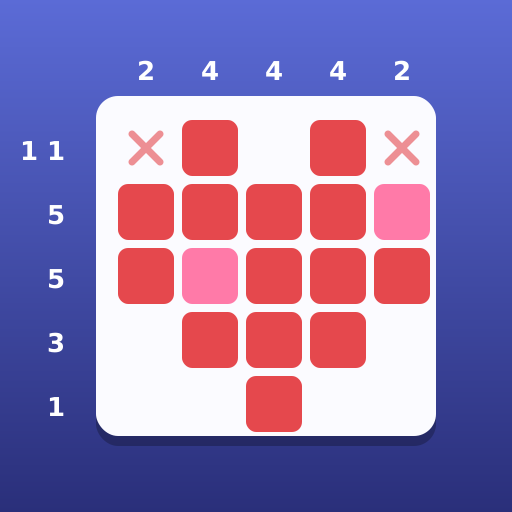
Every row has a clue on its left, and every column has a clue on top. Each number in a clue is a run: a block of filled squares side by side. The numbers are in order, and between two runs there is always at least one empty square.
So a row clue of 3 1 means: somewhere in this row there is a block of three filled squares, then at least one gap, then one single filled square. Nothing else in that row is filled. A clue of 0, or an empty clue, means the whole line is blank.
The puzzle is to find the one arrangement of filled and empty squares that satisfies every row and every column at the same time.
Start with lines that solve themselves
Add up the runs in a clue, plus one gap between each pair of runs. If the total equals the width of the grid, the line has only one possible arrangement. In a ten-wide row, a clue of 4 5 adds up to 4 + 1 + 5 = 10, so the row is fully decided: four filled, one empty, five filled.
A single number equal to the width fills the whole line. These are the easiest wins, so fill every one of them before doing anything else.
The overlap trick
Most lines are not fully decided, but many are partly decided. Take a fifteen-wide column with the clue 9. Push that block of nine as high as it can go and it covers squares 1 to 9. Push it as low as it can go and it covers squares 7 to 15. Squares 7, 8 and 9 sit inside the block in both positions, so they are filled no matter where the block really ends up.
The same trick works with several runs: push all of them to the left, then all of them to the right, and any square covered by the same run both times is certain. This one technique cracks the opening of almost every nonogram.
Cross out what must be empty
Filled squares get the attention, but empty squares are just as useful. When a line's clue is complete, every remaining square in it is blank: mark those with a cross. A crossed square tells the crossing column that it cannot extend through that spot, which often settles another run.
In our Nonogram game, switch to Cross mode with the button under the grid, or right-click on a computer, to mark blanks. Lines you finish are crossed off for you, and their clues fade so you can see what is left.
Work back and forth
Nonograms are solved by conversation between rows and columns. Each square you fill or cross in a row gives the crossing column a new fact, and vice versa. A good rhythm is to sweep all the rows, then all the columns, then the rows again. Each sweep usually unlocks something the previous one could not.
Look at the edges
A filled square touching the border has to be the start (or end) of a run. If the first number of a column clue is 3 and the top square is filled, the next two squares are filled too, and the one after that is empty. Edges turn single filled squares into whole runs.
Finding which run is which
On busier grids, the hard part is knowing which filled square belongs to which run. Use size: if a row's clue is 1 4 and you have found a block of two filled squares, it cannot be the 1, so it is part of the 4. Then the 4 can only stretch so far in each direction, which may let you fill or cross more squares.
What to do when you are stuck
- Re-check every line where the clue's total is close to the width; overlaps may have appeared since your last sweep.
- Look for runs that are already fully placed and cross out their neighbours.
- Compare the biggest number in a line with the space between crossed squares. A run of 5 cannot fit in a gap of 4.
Start small and grow
Five by five puzzles teach the clue reading; ten by ten puzzles are where the overlap trick and back-and-forth sweeps really shine. Our Nonogram game starts small and grows in size chapter by chapter, and each picture blooms into color when you finish. If you enjoy the rhythm of using one clue to unlock another, the number clues in Minesweeper and the row-and-column logic of Sudoku work the same mental muscles in a different setting.